If you do your own link building, you'll get the offer sooner or later: "I'll link to you if you link to me." Some SEOs say link exchanges are a quick win, others say they'll get you penalized, and most guides land on "it depends" without telling you what it depends on.
This guide is the practical version. It covers what a link exchange is, the forms it takes and how risky each one is, what Google has said about them, and a step-by-step process for doing them in a way that's actually worth your time.
What is a link exchange?
A link exchange is when two sites agree to link to each other. Site A adds a link to site B, and in return, site B adds a link to site A. The goal is usually SEO: both sites want more backlinks, so they trade.
In B2B it often looks like this: a SaaS invoicing tool and an accounting blog each cite one of the other's guides, or two non-competing tools for the same audience mention each other in a relevant article.
Link exchange vs. reciprocal link vs. link swap
People use these terms interchangeably, but they're not the same thing:
- A reciprocal link is the pattern: A links to B and B links to A. It can happen with no agreement at all. (We cover how Google treats that pattern in our guide to reciprocal links.)
- A link exchange or link swap is the agreement. It doesn't always produce a reciprocal pair: in a three-way exchange, the return link comes from a different site.
The distinction matters because Google cares about why a link exists, not just which way it points.
A brief history
Link exchanges are as old as the web. In the late 1990s, banner networks like LinkExchange let sites show each other's ads, and "links pages" full of swapped links were everywhere. Once Google started ranking pages by links, those swaps became an SEO tactic, and Google's guidelines started warning against them. The wording it uses today, "Excessive link exchanges ('Link to me and I'll link to you')," has been in its guidelines for well over a decade.
Types of link exchange (and how risky each one is)
Direct swap
Low riskA links to B because B links to A. Fine now and then between relevant sites; a problem as a habit.
Guest post swap
Medium riskEach side writes an article for the other, with a link back to the author's site. Only as good as the posts.
Partner or links page
High riskA page that exists to hold swapped links. Google's spam policy names it explicitly.
Credit network or loop
High riskSites in a pool pass links around for credits, so nobody swaps directly. The pattern link spam systems look for.
| Type | How it works | Risk |
|---|---|---|
| Direct swap (A ↔ B) | Each site links to the other | Low when occasional and relevant; risky as a habit |
| Three-way (ABC) exchange | B links to A, A links to C, and B and C share an owner | Same as a swap, plus it looks like hiding one |
| Guest post swap | Each side writes an article for the other's blog | Low to medium, depending on the content and anchors |
| Partner or links page | A page listing partners' links | High: Google names it in its spam policy |
| Credit networks and loops | Pools of sites pass links around for credits | High: this is what link spam systems are built to catch |
| Natural B2B cross-linking | Integration docs, case studies, co-marketing, podcast appearances | None: it's how B2B links happen anyway |
The pattern across the table: the more editorial the link and the more visible the reason for it, the lower the risk. The more a setup exists to hide the deal, the higher it goes. (If you've been offered a three-way swap, we explain why ABC exchanges aren't safer.)
How Google treats link exchanges
Google's spam policy lists "Excessive link exchanges ('Link to me and I'll link to you') or partner pages exclusively for the sake of cross-linking" as link spam. The key word is excessive: Google doesn't say every link between two sites that know each other is a problem.
John Mueller made the line clearer in a short 2019 video. When you link to a site "because of an arrangement, like you link to me and I'll link to you," Google recommends making that link nofollow. Natural links to sites you'd recommend anyway are fine.
In practice, that means an introduction is fine but a condition is not. Meeting a relevant site and linking to each other's best pages because they help your readers is normal. A link that only exists because the other side owes you one is what Google wants qualified.
Google has also gotten better at spotting the pattern. In December 2022, it announced that SpamBrain, its AI-based spam system, could now detect sites buying links and "sites used for the purpose of passing outgoing links."
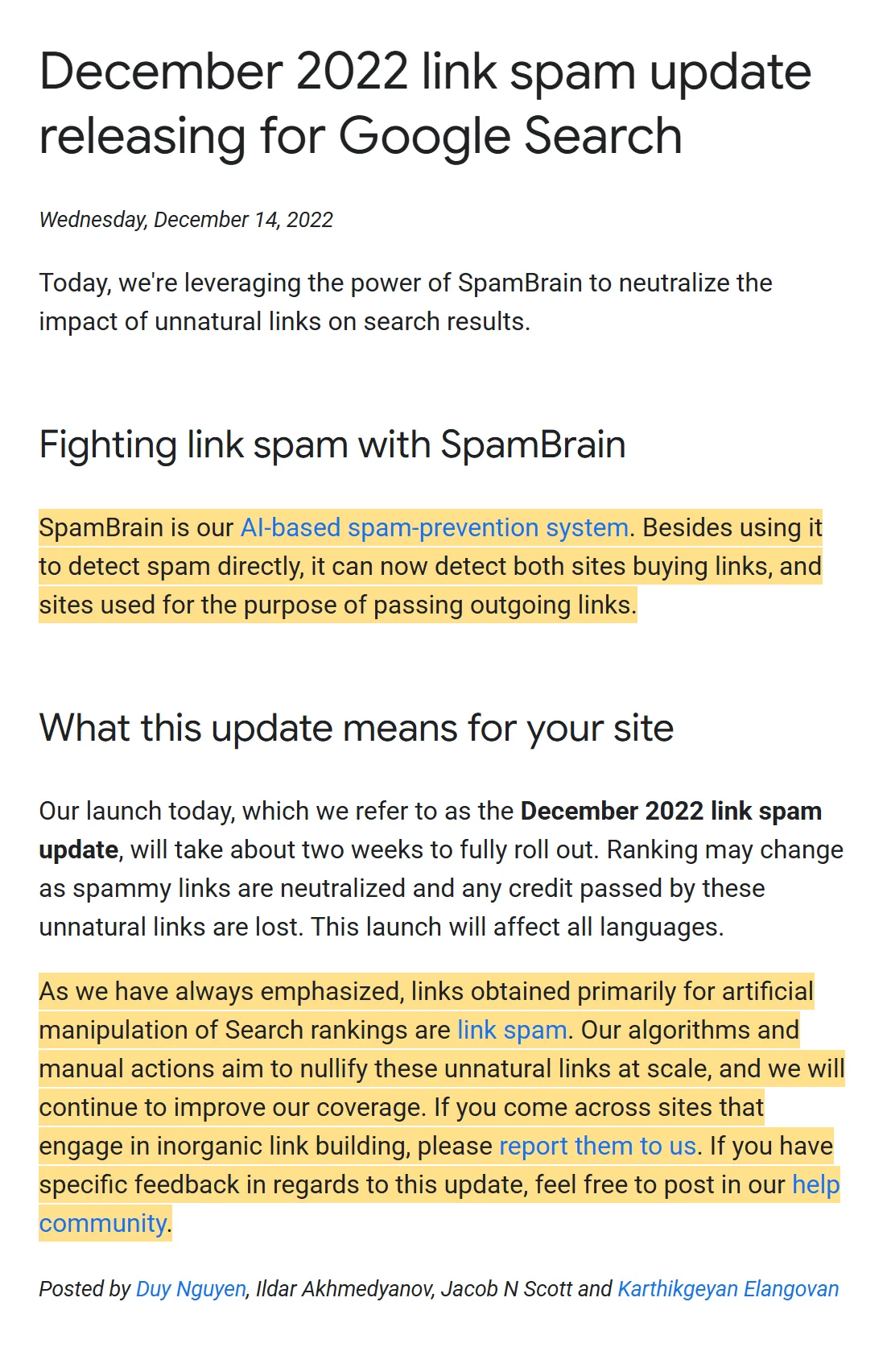
What happens to exchanged links: ignored, or a manual action
In most cases, Google's systems simply ignore links they read as part of an exchange. You don't get a penalty, but you don't get any value either.
For sites where exchanges become a large-scale pattern, a manual action is possible. It shows up in Search Console under Security & Manual Actions → Manual actions. If the problem is the links you give out, it's called "Unnatural links from your site," and Google's fix is explicit:
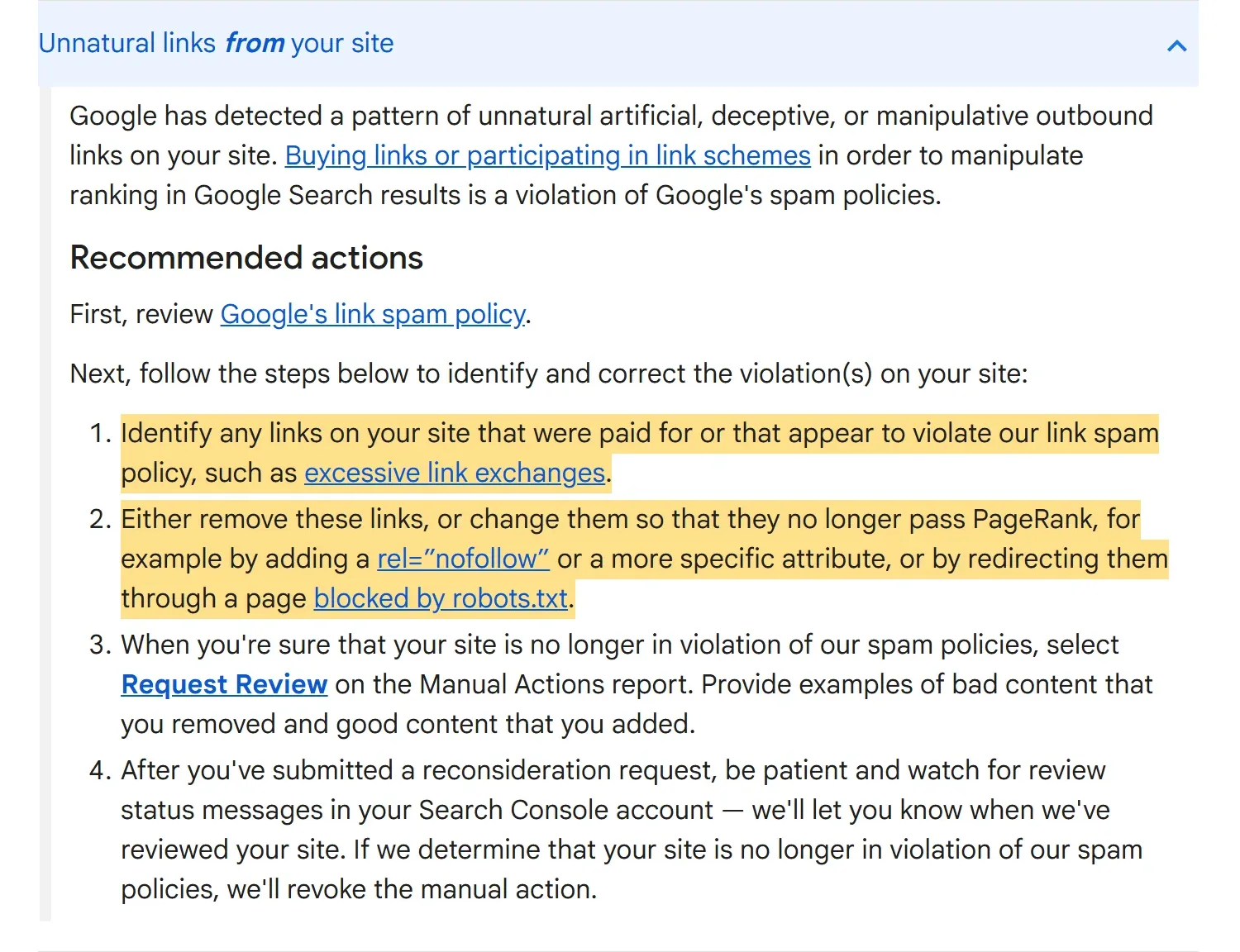
For the full timeline of what Google has said about sites linking to each other, see what Google actually says about reciprocal links.
Are link exchanges worth it?
Sometimes. Links are still part of how Google understands and ranks pages; its own ranking systems guide says PageRank "continues to be part of our core ranking systems." So a relevant link from a real site has value. The question is whether an exchange is a good way to get one.
What a good exchange gets you
- A relevant link from a site in your niche, on a page about your topic.
- Referral traffic, if the page has readers who are your kind of customer.
- A relationship. The partner you swap one link with today is the one who invites you on their podcast, quotes you in a report, or co-hosts a webinar next year. In B2B, that's often worth more than the link.
What it costs: the time math
Exchanges aren't free just because no money changes hands. Finding a relevant partner, checking their site, writing a pitch, agreeing on placement, and following up adds up. Digital Gratified's "conservative estimate" is 2–4 hours per successful link exchange, and since you might email 20 sites to land one or two, that's 10–20 hours of work for a couple of links.
That's the honest reason to be selective. If Google ignores a link because it reads as a swap, the hours you spent on it are simply gone. A few well-chosen exchanges with partners you'd recommend anyway are worth the time; a hundred random ones aren't.
Where exchanges fit in a link strategy
Treat exchanges as a supplement. Most of your links should come from things people link to on their own: original data, useful tools and templates, expert quotes, and partnerships. If you stopped swapping links tomorrow and your link growth stopped too, exchanges have become your strategy, and that's the pattern Google's policy describes.
How to do a link exchange safely, step by step
- 1OfferA page of yours worth citing
- 2FindSame-niche sites, similar audience
- 3VetReal business, real traffic
- 4ProposeOne specific placement
- 5PlaceIn body copy, where it helps
- 6TrackLive, followed, indexed
Anything conditional or paid? Qualify the link with rel="nofollow" or rel="sponsored".
Link removed later? Ask once, then decide if your link still helps your readers.
1. Decide what you can offer
Start with your own site. Which pages could you honestly link from? A guide, a comparison page, a "tools we use" section, integration docs. And which of your pages would someone else want to cite? If the answer is "our homepage," fix that first: exchanges work best when you have a genuinely useful page to point to.
2. Find relevant partners
Look for sites with the same audience as you but a different product: same or adjacent B2B niche, non-competing, with readers who'd plausibly be your customers. Ignore "similar DR" as a filter; relevance matters far more. (We cover where to look further down.)
3. Vet them like a vendor
Before any link goes either way, check:
- It's a real business: a product, pricing, a team, named authors.
- It has real readers: organic traffic that's stable or growing (the free versions of Ahrefs and Semrush show the trend), and pages that rank for something relevant.
- Its outbound links are clean: no "write for us, link exchange available" page, no sitewide footer links, no links to casino, loan, or CBD sites.
- A real person replies, from an email on their own domain.
Then run the specific link through our 5-question test. The most important question: would you link to that page even if they never linked back?
4. Propose a specific placement
Don't send "let's exchange links." Name the exact page and section on their site where your page would help their readers, and explain why in a sentence. Suggest where you'd link to them in return, but don't make your link a condition of theirs.
Showing beats telling. People who include a screenshot or a quote of the paragraph where the link would go report noticeably more replies. For a full email you can copy, see our outreach template.
5. Place links editorially
Put the link in the body of a relevant page that's indexed and already gets traffic, not on a new post nobody will visit. Use anchor text that fits the sentence: brand names and plain descriptions are fine, the same keyword-rich phrase on every link isn't. No footers, sidebars, or partner pages.
If anything about the link is conditional or paid, qualify it with rel="nofollow" (or rel="sponsored" when money, products, or services changed hands). It still sends readers your way.
6. Verify and track
Links disappear. Pages get redesigned, posts get pruned, and some partners quietly switch links to nofollow once you've checked them. A simple spreadsheet is enough:
| Column | What to record |
|---|---|
| Partner | Site and contact |
| Their link | The page linking to you, and the page it points to |
| Your link | Your page linking to them, and where it points |
| Anchor + rel | The anchor text, and whether it's followed or nofollow |
| Date live | When the link went up |
| Last checked | When you last confirmed it's live and indexed |
Check every few months. Open the page, inspect the link to see its rel attribute, and look in Search Console's Links report to confirm Google has picked it up.
7. Handle removals gracefully
If a link disappears, ask once, politely; it's often an accident. If it's gone for good, look at your own link to them. If it still helps your readers, keep it. If it only existed because of the deal, that's a sign it shouldn't have been there in the first place.
Where to find link exchange partners
Every option has trade-offs, and most "best link exchange site" lists are written by someone selling one. Here's an honest comparison:
| Where | Pros | Cons |
|---|---|---|
| Your network: integrations, customers, partners | The most relevant; links happen naturally | Limited supply |
| Cold outreach | You pick exactly who | Slow, and most swap requests get ignored |
| Niche Slack, Discord, and Facebook groups | Real site owners swapping manually | Quality varies a lot; many members run link networks |
| Subreddits | Free and active | r/bigseo bans exchange posts; dedicated subreddits are mostly "DM me" offers |
| Marketplaces and credit platforms | Volume | Credit loops are the network pattern Google targets |
| Matching services like Exchange Backlinks | Niche matching, introductions only, you stay in control | You still vet and agree placements yourself |
For a side-by-side of the platforms, see our comparison of link exchange sites. And if your goal is links rather than swaps specifically, expert-quote platforms like HARO and Help a B2B Writer earn links with nothing owed in return.
Should you exchange links with competitors?
Usually not, and most SEOs agree: in a 2011 Search Engine Roundtable poll, 50% said they'd never exchange links with a competitor and only about 20% actively did. A link to a direct competitor rarely helps your readers, and they're unlikely to place your link where it matters. Look for complementary businesses instead: tools your customers use alongside yours, agencies that serve your market, and publications your audience reads.
How to get link exchanges when your site is new
This is the most common frustration in SEO communities: you reach out for an exchange, and the reply is "minimum DR 35 and 1,000 visits a month." When your site is new, that's a closed door.
Some ways around it:
- Stop pitching DR. Domain Rating is an Ahrefs metric, not something Google uses. Pitch relevance: why your page is useful to their readers.
- Offer something besides a link. A guest post written for their audience, a customer testimonial, a quote for an article they're writing, or a mention in your newsletter.
- Start where links happen naturally: integration partners, the tools you use, founder communities, and small niche blogs that are growing too.
- Build one page worth linking to. A useful template, calculator, or piece of original data makes every conversation easier.
Common link exchange mistakes
- Choosing partners by DR instead of relevance and real traffic.
- Using three-way swaps to "hide" the exchange. There's still a deal, and the setup itself looks like one.
- Partner pages, footers, and sitewide links. Google's policy names partner pages explicitly.
- The same exact-match anchor on every swap.
- Trusting a "safe percentage." You'll see 10%, 15%, or 30% quoted. Google has never published a number.
- Swapping again and again with the same site.
- Joining credit-based link networks that place your links on sites you never vetted.
- Making exchanges your main source of links.
Alternatives to link exchanges
If you want links without trading them:
- Expert quotes through source-request platforms like HARO, Featured.com, and Help a B2B Writer.
- Linkable assets: original data, templates, calculators, and free tools people cite on their own.
- Integration and partner pages that document how your product works with others.
- Digital PR around something new: a launch, a dataset, a strong opinion backed by numbers.
And if you'd rather not spend your week on outreach at all, Mentiohunt, built by the team behind Exchange Backlinks, finds the sites where your content belongs and handles the outreach for you.
Frequently asked questions
Is a link exchange the same as a reciprocal link?
Not quite. A reciprocal link is the result: two sites that link to each other. A link exchange is the agreement that produced it. Plenty of reciprocal links happen with no agreement at all, and some exchanges (three-way swaps, guest post swaps) don't produce a direct reciprocal pair.
Are link exchanges against Google's guidelines?
Excessive ones are. Google's spam policy lists "excessive link exchanges" as link spam, and John Mueller has said links that exist because of an arrangement should be nofollow. Occasional links between relevant sites that help each other's readers are normal.
How many link exchanges per month is safe?
Google has never published a number, so any "safe" count or percentage is a guess. What matters is that exchanges stay a small, slow-growing share of your links, with relevant partners and editorial placements. A sudden burst of swaps is a pattern; two good ones a quarter is not.
Does DR or DA matter when choosing a link exchange partner?
Less than people think. Domain Rating and Domain Authority are third-party metrics that Google doesn't use. A smaller site in your exact niche, with real readers and pages that rank, is usually a better partner than a high-DR site about everything.
Is it OK to exchange links with the same site more than once?
Occasionally, if each link stands on its own. A steady stream of links back and forth with one domain is exactly the kind of pattern that looks like a deal, so spread your relationships across several sites instead.
Link exchange or guest post exchange: which is better?
A guest post swap gives each side a full article, so the link comes with real context and the readers get something useful. It's more work, but it holds up better than dropping links into existing pages. Either way, the quality of the content decides whether it's worth it.
Should the link go on an existing page or a new article?
An existing page that's indexed and already gets traffic is usually better. A link on a brand-new post nobody visits sends no readers, and a page published only to hold a swapped link looks like what it is.
What if my partner removes my link or makes it nofollow?
Ask once, politely. Links get removed in redesigns and content updates more often than out of bad faith. If it's gone for good, look at your own link to them: keep it if it helps your readers, remove it if it only existed because of the deal.
How can I tell if a partner is part of a link network?
Warning signs: they offer links from "sites in all categories," they own a long list of similar sites, they suggest a three-way swap from a different domain, or the site has a "write for us" page and outbound links to unrelated businesses. Real partners have one site, a product, and a specific reason to link to you.
Is it OK to cross-link with an integration or business partner?
Yes. Integration docs, partner directories, and case studies linking both ways are the most natural form of B2B reciprocity. Keep the links on the pages where they make sense, not in footers or sitewide blocks.
Do link exchanges help with AI search like ChatGPT or Perplexity?
There's no evidence either way yet. AI assistants cite pages that are widely referenced and relevant, which is the same thing a good editorial link helps with. A swapped link on a page nobody reads is unlikely to change much anywhere.
Are link exchanges worth it for referral traffic, or only SEO?
The best ones do both. If a link sits on a page your audience actually reads, it can send visitors and signups regardless of how Google values it. If you can't imagine anyone clicking it, that's a good sign it's not worth placing.

Written by
Nicolas More
Founder of Mentiohunt and Exchange Backlinks
Nicolas is a bootstrapped founder who built backlinks by hand for his own product before automating the prospecting and outreach with Mentiohunt. He started Exchange Backlinks as a free way for B2B teams to meet relevant sites in their niche.